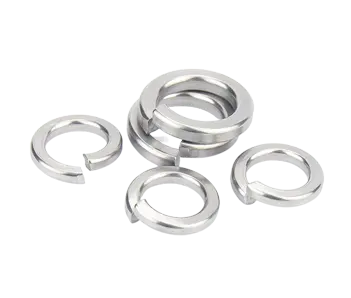
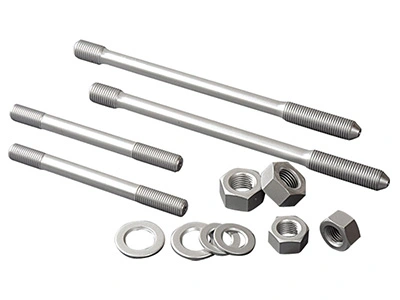
The anti-loosening effect of a spring washer comes from its ability to exert a continuous elastic force after being compressed flat. This elastic force maintains friction between the threads of the nut and bolt, generating a resisting torque that helps prevent the nut from loosening. Additionally, the sharp edges at the open end of the spring washer embed slightly into the bolt and the surface of the connected part, helping to prevent relative rotation between the bolt and the connected component.

A spring washer is widely used in general mechanical products, both in load-bearing and non-load-bearing structures. Its advantages include low cost and ease of installation, making it suitable for parts that require frequent assembly and disassembly. However, the actual anti-loosening capability of a spring washer is quite limited! In fact, its use in highly reliable products demanded by many Western countries is very rare, and it has long been abandoned in critical load-bearing connections. In China's military industry, some applications remain, but stainless steel materials have replaced the traditional ones. It is even said that a steel spring washer has long been banned in CASC (China Aerospace Science and Technology Corporation) due to safety concerns, primarily because of two reasons: ring expansion and hydrogen embrittlement.
In the connection between a vehicle axle main reducer and the axle housing, 10.9-grade M16×100 bolts were tightened with a torque of (280 ± 20) N·m using a high-precision electric torque wrench. The torque-angle relationship during bolt tightening was tested both with and without a spring washer. Comparing the torque-angle curves showed that with a spring washer, there was a consistent preload torque of about 10 N·m, whereas without a spring washer, the torque remained at zero before sharply rising.
This suggests that a preload torque of approximately 10 N·m is sufficient to fully compress the spring washer. Further verification with a digital torque wrench confirmed that the spring washer was completely flattened before the bolt torque reached 20 N·m, validating this inference.
Analysis of these observations indicates that a spring washer only provides about 10 N·m of elastic force. Compared to a bolt preload torque of 280 N·m, this force is negligible. Moreover, such a small force is insufficient to embed the sharp edges at the washer's opening into the bolt or connected part surfaces. Post-disassembly inspection found no visible indentations on either surface. Therefore, the anti-loosening effect of a spring washer on bolts can be considered negligible.
Furthermore, adding an additional washer between the bolt and the connected part may introduce another potential safety hazard if the washer quality is poor.
When bolt torque is relatively high (above 200 N·m), using a spring washer as a means of preventing loosening does more harm than good. Under conditions of impact, vibration, and variable loads, the preload may momentarily disappear, leading to possible loosening of the connection.
NASA has also identified problems with open spring washer. In their standards regarding locking nuts, it states:" A typical helical spring washer acts as a spring during bolt tightening. However, once the bolt is fully tightened, the washer generally becomes flattened. At this point, it effectively acts as a flat washer and offers no locking function. In summary, this type of locking washer is ineffective for securing purposes".
That said, some experts disagree with this view. What are your thoughts?


 中文
中文 English
 日本語
日本語 한국어
한국어 français
 Deutsch
 Español
 italiano
 русский
 português
 العربية
 Türkçe
 ไทย
ไทย