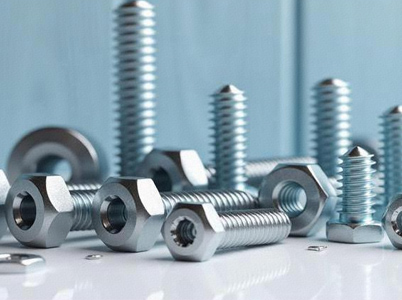
The nylon insert locking nut is one of the most common and widely used locking nuts. It features a simple structure where a nylon ring is inserted into the nut head. During the tightening process, the nylon ring naturally compresses into the threads, creating a tight fit with the bolt. This design generates frictional resistance due to the elasticity of the nylon, effectively preventing loosening. Although it can be reused, the nylon's resistance to heat and acids is relatively weak, so it should not be used in environments with acidic or alkaline conditions. It is recommended to limit its usage to no more than 5 times.
Metal Locking Nuts
The metal locking nut works by deforming the thread's base or the thread profile during installation, increasing the friction between the threads to prevent loosening. Compared to nylon locking nuts, metal self-locking nuts offer better anti-loosening performance and are suitable for environments with higher temperature and acid-alkali corrosion. However, the dimensional control precision of metal locking nuts is relatively high, making them unsuitable for applications with significant vibration loads.
Sibolock Locking Nuts
The Sibolock locking nut features an innovative self-locking internal thread design that alters the thread angle to create a 60° friction force, significantly improving anti-loosening performance. Although more expensive, it excels in preventing loosening and is suitable for a wide range of temperature and shock-vibration conditions.
Flanged Locking Nuts with Teeth
The flanged locking nut with teeth generates compressive force during tightening, with the teeth embedded into the mating surface to increase friction, achieving effective anti-loosening. This type is particularly suitable for lightweight metal connections with lower strength requirements.
Slotted Locking Nuts
The slotted locking nuts automatically expand at the tail end of the nut during installation, creating frictional resistance through the deformation of the closing end, effectively preventing loosening. While reusable, its performance diminishes with each use.
Tandem Locking Nuts
The tandem locking nut uses two nuts with opposite thread directions to create a locking mechanism. By converting the loosening force of the right-hand thread nut into the tightening force of the left-hand thread nut, it ensures the nut will not loosen. This design represents a significant breakthrough in traditional thread concepts.
Other Locking Nuts
In addition to the common types mentioned above, there are other specially designed locking nuts, such as the "never-loosen" HARD-LOCK nut, and the convex-concave slope locking nut. These nuts are used in specific industries and structures, providing solutions for unique operating conditions.
When selecting a locking nut, it is essential to consider factors such as anti-loosening performance, durability, and cost based on the specific application environment and requirements. This ensures the reliability and safety of the connection. With so many types of locking nuts available, have you found the one that suits your needs?



 中文
中文 English
 日本語
日本語 한국어
한국어 français
 Deutsch
 Español
 italiano
 русский
 português
 العربية
 Türkçe
 ไทย
ไทย