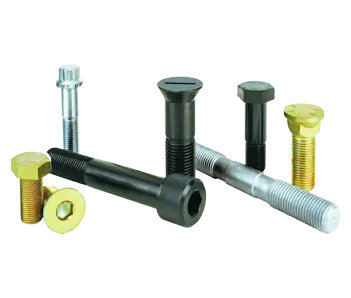
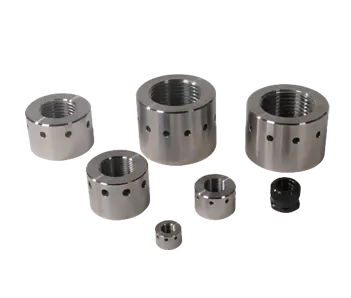
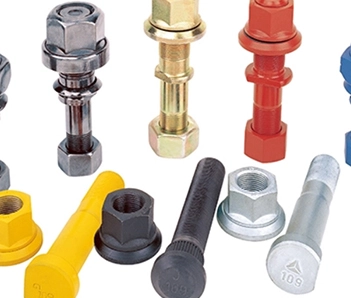
In vehicle assembly, the connection commonly uses a fastener bolt and metal nut pairing. During assembly, whether tightening the fastener bolt or the metal nut, a rotation phenomenon can occur. This is because the frictional torque between the support surface of the untightened fastener bolt or metal nut is smaller than the frictional torque in the threaded connection, leading to the rotation of the fastener in the assembly process.
The chassis of Scania vehicles in Sweden employs a dual-metal nut design, which effectively addresses the issue of rotation during assembly. Furthermore, this design ensures that the metal nut will not loosen during vehicle operation. However, the downside is that, during assembly, only the fastener bolt can be tightened, and more importantly, the manufacturing cost is significantly higher than that of conventional flange nuts.

To improve vehicle assembly quality, many OEMs (Original Equipment Manufacturers) adopt electric tightening machines for key assembly positions. However, if a large number of metal nuts are used, it could significantly increase the overall manufacturing costs of the vehicle. In the increasingly competitive automotive market, it is crucial to find a solution that addresses the anti-rotation issue without substantially increasing manufacturing costs.
Many OEMs have conducted assembly tests using parts with flange surfaces enhanced with locking teeth structures and parts with increased flange tilt angle and galvanized coatings. Among these, the flange surface with locking teeth structures showed significant improvements, with no rotation issues, while the galvanized parts with an increased flange tilt angle still exhibited severe rotation problems.
Regarding fastener bolt assembly, a common issue is the instability of preload due to large variations in the friction coefficient. In our trial assembly, we used metal nut with locking teeth in two scenarios. When fastener bolt with locking teeth is tightened during assembly, the locking teeth damage the surface of the connected parts, resulting in an unstable friction coefficient on the support surface, which ultimately leads to unstable preload.However, when using metal nut with locking teeth, we tighten a flange fastener bolt without locking teeth, keeping the metal nut stationary. Since the locking teeth of the metal nut do not affect the friction coefficient during assembly, they do not impact the preload during the assembly process. Thus, the assembly preload remains stable.

Of course, the locking teeth on the metal nut may cause some damage to the electrophoretic coating on the vehicle frame steel sheet. While this damage may not necessarily be more severe than the damage caused when a non-locking metal nut experiences rotation, reducing this damage would undoubtedly enhance our confidence in using this method to solve the anti-rotation issue.
Therefore, we have developed a structure with a long convex point featuring a circular arc cross-section, distributed around the edge of the end face. This structure may be the ideal solution to reduce the damage to the vehicle frame steel sheet's paint coating. During the initial stages of assembly, these convex points gently press into the surface of the steel sheet, causing minimal damage to the coating. Moreover, after vehicle assembly tests, the rotation issue occurred with zero incidence. We will continue testing other performance aspects to achieve a more perfect standard component anti-rotation structure.


 中文
中文 English
 日本語
日本語 한국어
한국어 français
 Deutsch
 Español
 italiano
 русский
 português
 العربية
 Türkçe
 ไทย
ไทย