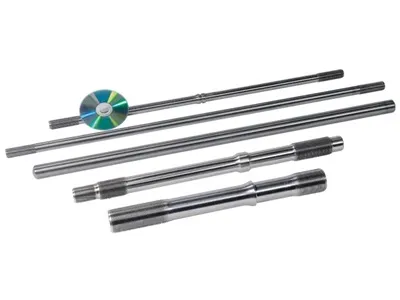
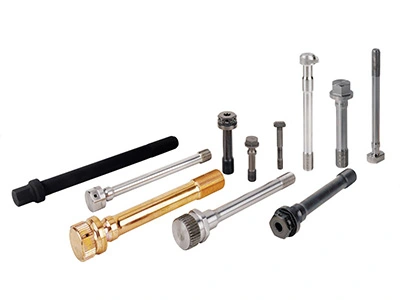
Strength: The ability of a metallic material to resist plastic deformation and fracture under external forces.
Plasticity: The ability of a metallic material to undergo permanent deformation without causing damage under external forces.
Testing method – Tensile test
Specimen preparation:
1. Sampling: Sampling from finished products or semi-finished products after heat treatment. Eccentric sampling, at 1/4 of the thread diameter. Specimen diameter according to GB/T 228.1-2010.
2. Specimen machining
3. Testing equipment
Tensile testing machine and related software
4. Test procedure
Clamp both ends of the specimen with the testing machine grips. Separate at a rate not exceeding 10 mm/min until the specimen is pulled apart. Record relevant data.
5. Test conclusions
1) Tensile strength: Rm = Fm / S0
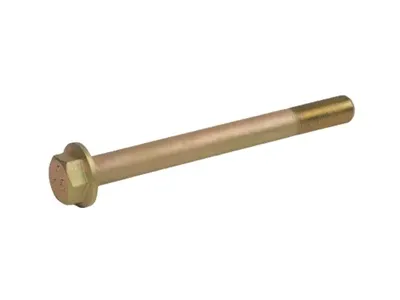
Requirement for class 10.9 high-strength bolts: Rm ≥ 1040 Mpa
2) Yield strength:
Upper yield strength: ReH = FeH / S0
Lower yield strength: ReL = FeL / S0
Requirement for class 10.9 high-strength bolts: ReL ≥ 940 MPa
3) Percentage elongation after fracture A
Bring the fractured specimen pieces together tightly along a straight line.
Measure L1 using a vernier caliper.
Calculation: A = (L1 – L0) / L0
Requirement for class 10.9 high-strength bolts: A ≥ 9%
4) Percentage reduction of area Z
Bring the fractured specimen pieces together tightly along a straight line.
Measure the cross sectional diameter d1 at the fracture using a vernier caliper.
Calculation: Z = (d0 – d1) / d0
Requirement for class 10.9 high-strength bolts: Z ≥ 48%



 中文
中文 English
 日本語
日本語 한국어
한국어 français
 Deutsch
 Español
 italiano
 русский
 português
 العربية
 Türkçe
 ไทย
ไทย